AI brand voice: Your voice in every draft. Not a generic one.

Verand reads your own pages at onboarding and keeps what it learned: how you write, who signs the work, and what your images look like. Every article starts there, and none of it is invented.

JR
Brand Hub

The authority and voice the Article Generator puts into every draft.

Brand & Voice

The positioning, audience, and voice the generator writes in.

Re-reads your site and drafts product cards from your last crawl. 5 of 10 left this month.
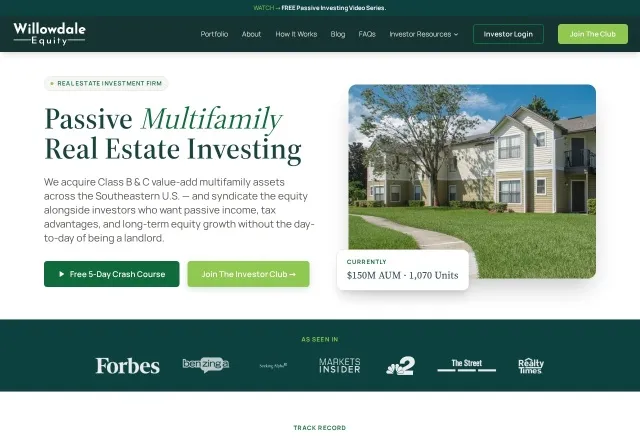
Willowdale Equity homepage

Willowdale Equity

willowdaleequity.com
Industry

Real estate syndication

Detected and confirmed during onboarding.

Site files

Cloudflare is refusing GPTBot, ClaudeBot, anthropic-ai, CCBot, Bytespider, Amazonbot before robots.txt is read. See Site Health.

About Your Brand

Describe your company, who you help, and what makes you different.

At Willowdale Equity, we're a private multifamily real estate investment firm that acquires and operates Class B/C value-add apartment communities across the southern U.S., with our main concentration in Middle Georgia and Texas. We've sponsored over $150M in multifamily assets.

We help busy, high-income professionals and accredited investors passively invest alongside us as limited partners: giving them direct ownership, monthly/quarterly cash flow, pass-through tax advantages, and appreciation without the headaches of being a landlord. Investors come in through the Willowdale Equity Investment Club and can deploy capital as individuals, through a self-directed IRA, solo 401(k), qualified retirement plan, or business entity.

What makes us different is that we're operators, not just marketers. We force value through NOI growth rather than betting on market appreciation, underwrite conservatively with real reserves built in, and communicate openly with our investors. Our 69-unit Mill Gardens case study: where we doubled the property's value in under 15 months: is how we'd rather prove it than promise it.

Brand Voice & Tone

Define how your brand sounds, and the author persona it writes as.

Brand Voice & Tone

Direct, specific, and honest. A plain-spoken operator voice: concrete numbers over adjectives, mechanics over hype. Educational and credible without being salesy. Every claim is grounded in how deals actually work, risk is stated plainly, and returns are never overpromised.

Author Persona

You are a multifamily operator and sponsor who understands acquisitions, underwriting, capital markets, and investor reporting from the inside. You've sponsored over $150M in Class B/C value-add apartment communities across Georgia and Texas, and you write the way you'd explain a deal to a smart but busy professional weighing a passive investment. You translate complex syndication mechanics: waterfalls, K-1s, depreciation, refinances, NOI-driven forced appreciation: into clear, practical language without dumbing them down. You never overpromise returns, you flag risk honestly, and you write from real operating experience rather than recycled finance-blog theory. Your goal is to educate accredited investors so they can make confident decisions, not to hype.

Forbidden:hidden gemboastsstunningluxiriousdream homeoasiselevatein today's marketdive inworld-classseamlessgame-changerunparalleled

Target Audiences

The audiences you tailor content for.

Accredited Passive Investors

Accredited investors (per SEC criteria) looking to passively invest in multifamily syndications as limited partners. They want cash flow, tax advantages, and appreciation without the headaches of being a landlord. Already understand or are actively evaluating partnership (LP) investments.

Busy High-Income Professionals

Time-strapped W-2 earners and self-employed professionals: doctors, attorneys, executives, business owners: with capital to deploy but no time to actively manage real estate. Want diversification into hard assets and an inflation hedge while keeping their day job.

Self-Directed Retirement Investors

Investors using a self-directed IRA, solo 401(k), or qualified retirement plan to invest in real estate. Researching how to deploy retirement capital into multifamily syndications and the tax/structure implications (custodian mechanics, UBIT/UDFI).

High-Net-Worth Individuals

HNW individuals focused on preserving and growing capital, generating predictable passive income, and accessing institutional-quality multifamily deals. Priorities are capital preservation, tax efficiency, and steady distributions.

Strong Opinions

  • Reserves are non-negotiable. We underwrite real operating and capex reserves into every deal: running thin on reserves is how sponsors get forced into bad decisions.
  • Value in multifamily is forced through NOI growth, not bought on market appreciation. If the business plan depends on the market going up, it isn't a business plan.
  • Class B and C workforce housing is more resilient through downturns than Class A: in a recession people trade down into it, not out of it.
  • Conservative underwriting beats optimistic projections every time. We'd rather under-promise and over-deliver than hit a pro forma that only works in a perfect market.
  • Markets matter more than buildings. We buy in strong, insulated growth markets across the southern U.S.: main focus Middle Georgia: because job and population growth drive everything downstream.
  • Sponsor alignment is everything. The GP should have real skin in the game alongside LPs, not just collect fees.

Products & Services

What you offer. Kept for the article's closing call to action, and so articles never invent something you don't offer.

How should articles mention you? Optional

Your compliance pack keeps your products and services out of the article body. Rules here apply to the closing call to action only.

Name the Investment Club in the closing call to action only, and never next to a return figure.

Multifamily Real Estate SyndicationsAdded by you

What it is

Private LP investment opportunities in Class B/C value-add apartment communities across the southern U.S. Investors take a passive limited-partner position and share in cash flow, pass-through tax benefits (depreciation via K-1), and appreciation. Offered under Reg D Rule 506(c) to verified accredited investors.

Who it's for

Accredited investors who want passive exposure to value-add multifamily.

No source page
Closing call to action only
Willowdale Equity Investment ClubAdded by you

What it is

A private group of accredited investors who get first access to Willowdale's multifamily deals, deal-specific webinars, and the private investor portal. The primary onboarding path for prospective limited partners.

Who it's for

Accredited investors who want first look at new deals.

No source page
Closing call to action only
Free 5-Day Passive Real Estate Investing Mini-CourseAdded by you

What it is

A free video series introducing busy professionals to passive multifamily investing: how syndications work, what returns to expect, and how to vet a sponsor. The top-of-funnel lead magnet for new investor education.

Who it's for

Busy professionals new to passive real estate investing.

No source page
Closing call to action only
Weekly Multifamily NewsletterAdded by you

What it is

A Tuesday-morning email to 2,000+ subscribers covering multifamily news, market trends, rates, economic indicators, and policy updates. Keeps prospective and current LPs educated and engaged.

Who it's for

Current and prospective LPs who want the market in five minutes a week.

No source page
Closing call to action only
Willowdale Equity Investor ClubApproved

What it is

A private investment club for accredited investors that gives members first-look access to multifamily real estate syndication deals, plus a private portal, reporting, webinars and educational resources.

Who it's for

Accredited investors who want to invest passively in multifamily real estate syndications and share in the associated tax benefits.

More detail for articles
Closing call to action only

Your compliance pack doesn't allow articles to name these in the body. They're used only in the closing call to action, and to stop an article describing something you don't offer.

Drafted automatically after each deep crawl. Last crawl: Nov 5.A new page added since then is picked up by the next crawl.

Location

Countries and states/provinces you operate in. Drives multi-jurisdiction compliance.

United StatesPrimary

51 states: Alabama, Alaska, Arizona, Arkansas, California, Colorado, +45 more

Map

United StatesPrimary

51 states selected

Industry Governing Body

The regulators and authorities your content must abide by. Search a known body or add your own.

From your compliance packs

Base YMYL Foundation, US Real Estate Syndication, US Regulation D (506b/506c) : enforced by Verand, not editable here.

Quality standards

Your content is in a YMYL (Your Money or Your Life) category, so Google holds your site to a higher quality & trust bar.

Added by you

Regulation D (SEC)

United States (federal)

sec.gov

SEC exemptions (Rules 504/506) that let private companies raise capital without a full public registration, subject to investor-accreditation, general-solicitation, and disclosure rules.

Real estate syndicationPrivate equityVenture capitalPrivate funds
Read from your pages

The voice is extracted,
not described.

Onboarding reads up to three of your long-form articles, chosen by their content, plus your homepage and about pages. Out of that come a style guide, the persona the generator writes as, and the phrases you would never use. You confirm it. You don't write it from a blank field. First-hand facts sit alongside it in the knowledge base.

Brand Voice & Tone

Define how your brand sounds, and the author persona it writes as.

Brand Voice & Tone

Direct, specific, and honest. A plain-spoken operator voice: concrete numbers over adjectives, mechanics over hype. Educational and credible without being salesy. Every claim is grounded in how deals actually work, risk is stated plainly, and returns are never overpromised.

Author Persona

You are a multifamily operator and sponsor who understands acquisitions, underwriting, capital markets, and investor reporting from the inside. You've sponsored over $150M in Class B/C value-add apartment communities across Georgia and Texas, and you write the way you'd explain a deal to a smart but busy professional weighing a passive investment. You translate complex syndication mechanics: waterfalls, K-1s, depreciation, refinances, NOI-driven forced appreciation: into clear, practical language without dumbing them down. You never overpromise returns, you flag risk honestly, and you write from real operating experience rather than recycled finance-blog theory. Your goal is to educate accredited investors so they can make confident decisions, not to hype.

Forbidden:hidden gemboastsstunningluxiriousdream homeoasiselevatein today's marketdive inworld-classseamlessgame-changerunparalleled
Authors

Named people sign it,
with what they can prove.

Each profile carries a title, credentials, areas of expertise, a bio and linked profiles. The default byline puts a written-by and an optional reviewed-by on every new article; the editor can swap them per article. Onboarding copies only what your site already prints and never infers a credential.

Default byline

New articles are bylined with these authors. You can change them per article in the editor.

New articles link to it from the byline and the author box. Found by your latest crawl.

Shown in the byline of new articles that have no named reviewer (your default Reviewed by shows the reviewer instead). This is Verand's default. It holds because every way Verand puts this byline on your site needs someone on your team to approve the article first.

Authors carry the article byline and can be assigned per article.

Frank Thomas
Written by

Frank Thomas – Asset Manager

CCIM

Expertise: multifamily syndication · underwriting · investor reporting

Frank is the asset manager at Willowdale Equity. He runs the operating side of every deal: business plan execution, property-management oversight, LP reporting through the investor portal, and the planning that turns a value-add acquisition into a refinance.

His writing covers what passive investors actually ask about: how depreciation flows through a K-1, what to look for in a sponsor’s underwriting, and what happens to distributions when interest rates move.

PH
Reviewed by

Paul Hughes – Editorial review

Expertise: editorial review · securities disclosures

Paul reviews every article before it’s published, checking each figure, claim and disclosure against Willowdale’s offering documents.

He makes sure nothing reads as a promise of returns, and that every article carries the disclaimers its topic needs.

Hero references

Every hero matches
the images you chose.

A template is a set of reference images, plus your own rules only if every hero must always or never include something. Make it the default and every article's hero is generated as a style transfer from up to four of them, by the image engine you picked after seeing six draw it: the palette, lighting and composition hold while the subject changes with the article. Up to five templates; Auto uses your industry, audience, region and brand colours instead. If you make your own, set Hero images to I supply my own and new articles arrive ready for yours, with nothing generated.

Hero image templates

The wide image at the top of every article. Auto derives one from your brand; a template makes every hero match its reference style. Click a template to manage its references.

Hero images

Who makes the wide image at the top of each new article.

Auto

Tuned to your brand, no template

Willow Hero

4 references · ByteDance

Banned phrases

Your never-say list,
on every run.

Forbidden phrases are voice-level: hidden gem, oasis, dive in. They are written into the generator's instructions for every article, and a baseline of 21 AI-tell phrases is scanned after drafting and flagged in review. Regulated claims are a different list, under Sources and disclaimers, and those block.

Products & Services

What you offer,
drafted from your site.

Each deep crawl drafts a card for every product and service it finds: what it is, who it's for and its page. On a site with a compliance pack they're kept for the article's closing call to action, and so articles never invent something you don't offer.

Products & Services

What you offer. Kept for the article's closing call to action, and so articles never invent something you don't offer.

How should articles mention you? Optional

Your compliance pack keeps your products and services out of the article body. Rules here apply to the closing call to action only.

Name the Investment Club in the closing call to action only, and never next to a return figure.

Multifamily Real Estate SyndicationsAdded by you

What it is

Private LP investment opportunities in Class B/C value-add apartment communities across the southern U.S. Investors take a passive limited-partner position and share in cash flow, pass-through tax benefits (depreciation via K-1), and appreciation. Offered under Reg D Rule 506(c) to verified accredited investors.

Who it's for

Accredited investors who want passive exposure to value-add multifamily.

No source page
Closing call to action only
Willowdale Equity Investment ClubAdded by you

What it is

A private group of accredited investors who get first access to Willowdale's multifamily deals, deal-specific webinars, and the private investor portal. The primary onboarding path for prospective limited partners.

Who it's for

Accredited investors who want first look at new deals.

No source page
Closing call to action only
Free 5-Day Passive Real Estate Investing Mini-CourseAdded by you

What it is

A free video series introducing busy professionals to passive multifamily investing: how syndications work, what returns to expect, and how to vet a sponsor. The top-of-funnel lead magnet for new investor education.

Who it's for

Busy professionals new to passive real estate investing.

No source page
Closing call to action only
Weekly Multifamily NewsletterAdded by you

What it is

A Tuesday-morning email to 2,000+ subscribers covering multifamily news, market trends, rates, economic indicators, and policy updates. Keeps prospective and current LPs educated and engaged.

Who it's for

Current and prospective LPs who want the market in five minutes a week.

No source page
Closing call to action only
Willowdale Equity Investor ClubApproved

What it is

A private investment club for accredited investors that gives members first-look access to multifamily real estate syndication deals, plus a private portal, reporting, webinars and educational resources.

Who it's for

Accredited investors who want to invest passively in multifamily real estate syndications and share in the associated tax benefits.

More detail for articles
Closing call to action only

Your compliance pack doesn't allow articles to name these in the body. They're used only in the closing call to action, and to stop an article describing something you don't offer.

Drafted automatically after each deep crawl. Last crawl: Nov 5.A new page added since then is picked up by the next crawl.
Review statement

An honest review line
on every byline.

An article with no named reviewer carries your review statement in its byline. Verand's default says your team reviews and approves every article before it's published, and it holds because every way Verand puts an article on your site needs someone on your team to approve it first.

Shown in the byline of new articles that have no named reviewer (your default Reviewed by shows the reviewer instead). This is Verand's default. It holds because every way Verand puts this byline on your site needs someone on your team to approve the article first.

From your AI visibility scans

Named by AI engines
alongside you.

The brands AI assistants mention in the same answers as you, found by your AI visibility scans, with how often and which assistants named them. Add the ones that fit to your competitors in one click.

Named by AI engines alongside you

Brands AI assistants (ChatGPT, Claude, Perplexity…) mention in the same answers as you. Your AI-visible competitors, from your AI visibility scans. Add any that fit. Each count is the AI answers from the last 30 days that name the brand.

  • Fickling & Company4 mentions
    ChatGPTGeminiGoogle AI OverviewsGoogle AI Modefickling.com
  • Cortland2 mentions
    PerplexityChatGPTcortland.com
  • G2 MultiFamily Property Management1 mention
    Google AI Overviewsg2multifamily.com
  • Larimer Capital Group1 mention
    ChatGPTlarimercap.com
  • Peachtree Property Ventures1 mention
    ChatGPTpeachtreegroup.com

How it works

Read once, loaded every time.

Four steps, and the last one keeps the profile from going stale.

Start for free
Reading your articles + your key pages

3 articles · homepage · 2 identity pages

01

Read at onboarding

One pass over your articles and identity pages: voice, persona, banned phrases, authors, logo, colours and fonts.

About Your Brand

Describe your company, who you help, and what makes you different.

At Willowdale Equity, we're a private multifamily real estate investment firm that acquires and operates Class B/C value-add apartment communities across the southern U.S., with our main concentration in Middle Georgia and Texas. We've sponsored over $150M in multifamily assets.

We help busy, high-income professionals and accredited investors passively invest alongside us as limited partners: giving them direct ownership, monthly/quarterly cash flow, pass-through tax advantages, and appreciation without the headaches of being a landlord. Investors come in through the Willowdale Equity Investment Club and can deploy capital as individuals, through a self-directed IRA, solo 401(k), qualified retirement plan, or business entity.

What makes us different is that we're operators, not just marketers. We force value through NOI growth rather than betting on market appreciation, underwrite conservatively with real reserves built in, and communicate openly with our investors. Our 69-unit Mill Gardens case study: where we doubled the property's value in under 15 months: is how we'd rather prove it than promise it.

02

Confirm, don't author

Every card arrives filled. Edit anything or keep it; nothing waits on a blank form.

"author": {

"@type": "Person",

"name": "Frank Thomas",

"jobTitle": "Asset Manager",

"knowsAbout": ["Multifamily syndication", …],

"sameAs": ["https://www.linkedin.com/in/frank-thomas-willowdale/", …]

}

03

Loaded into every run

Voice and authors go into the generator's cached instructions; the byline and Person schema are emitted in code.

Your site has changed since we learned your brand.

We re-read it and drafted updates to these cards. Nothing changes until you review them.

04

Re-learned when your site moves

A crawl that finds three or more changed pages triggers a re-read, at most every 21 days. It proposes; you apply.

Questions

What people ask before they let it read their site.

What is read, what is kept, and what Verand will never make up.

Where does the voice come from?

From your own site. Onboarding reads up to three long-form articles, chosen by content rather than URL (a page carrying a form, or under 8,000 characters of prose, is skipped), plus your homepage and up to four about or services pages. If nothing readable is found the fields stay empty and you fill them in. Verand does not invent a voice.

What is in the voice profile?

A three-to-five-sentence style guide, a second-person author persona the generator writes as, 8 to 14 forbidden phrases, an about-the-brand summary built only from facts on your pages, a first set of product and service cards, and your audiences (up to five). All of it is editable in the Brand & Voice tab. First-hand facts are separate: they live in the knowledge base.

How does it learn what I sell?

Each product or service is a card: what it does, what the customer sees or who it's for, and optional details, linked to the page it came from. After each deep crawl, Verand drafts cards from product and service pages that aren't cards yet and checks each draft against the cards you already have. A draft is never used in an article until you approve it, and anything your compliance packs ban is taken out of it first, listed and never used. Re-learn drafts again from the last crawl and never overwrites a card. You can also write cards yourself, or with your own AI assistant through the connector's Describe your products playbook. How an article may then name them is set by your compliance pack.

Do forbidden phrases block publishing?

No. They are voice, not compliance. They go into the generator's instructions on every run, and a baseline of 21 AI-tell phrases (deep dive, seamless, nestled) is scanned after drafting and flagged as a warning. Claims that must never appear, such as guaranteed returns, live under Sources and disclaimers and in your compliance packs, and those block.

What does an author profile change in the article?

The byline under the H1 (Written by, plus Reviewed by when set), the author box at the end, and the Person node in the JSON-LD: jobTitle, hasCredential, knowsAbout, description and sameAs from the linked profiles. Three checks read it: V31 author identity, V32 credential signals, V53 a reachable bio. All three are advisory, feed the E-E-A-T dial, and never gate publishing.

Will Verand add a credential I don't have?

No. Onboarding records a credential only when it is printed on your site and leaves the field empty otherwise; bios are copied, never written. You add or edit the rest yourself, and the photo falls back to a monogram until you upload one.

Where does the competitor list come from?

Two lists sit side by side on the Competitors tab. Named by AI engines alongside you comes first: the brands AI assistants mention in the same answers as you, from the AI visibility scans. Discovered competitors are the companies ranking for the keywords you've researched that sell something close to what you sell, checked by AI against your Brand Hub: an online broker or quote site selling the same product counts, an agency doesn't count against a software business, and anything it can't judge stays on the list for you to decide. Rest the cursor on any of them for its Domain Authority beside yours. Discover from SERPs runs a fresh scan of your topics; its companies are saved and listed first until the next scan replaces them. Add any that fit, and switch on tracking for the ones you want watched, up to your plan's limit.

Can Verand tell whether Google lists me as a preferred source?

Not on its own: Google offers no public way to check, so Verand asks. The Preferred source on Google chip beside Re-learn opens Google's page for your site and asks whether it's listed. If it is, it shows two ways to add Google's button to your posts: yourself, with a link or Google's script, or with Author Bio Pro. A No asks again in 90 days, and Don't ask again stops it.

How many reference images does a hero use, and is any of this gated?

Up to five templates, each with its own reference images and, if you want them, rules every hero must always or never include. At generation at most four references go to the image engine you picked for that template. If it fails, Verand tries its default engine and then a backup from a different provider, still with your references, so the template's look holds; only if every engine fails does the draft get a plain editorial hero, flagged on the run. The Brand Hub is on every plan, with no cap on authors or phrases.

How it works in the help center: How to set up Brand Hub

Brand Hub

Your voice in every draft, not a generic one. Rank on Google and in AI answers from ChatGPT, Gemini, Google AI Overviews, Google AI Mode, Perplexity and Claude. Checked against your rules first.

Your voice, your first-hand facts, the phrases you never say and the credentials behind the byline, set once and read on every draft before a word is written.

Seven days, every feature unlocked, one click to cancel.

Compliance gate
Draft, paragraph 3

The 2019 fund returned 14.2% net to investors, and this offering carries guaranteed returns of 12 to 15% over a five year hold.

Base rules for every regulated siteHard rule

A guaranteed return is deceptive in any financial context and can be a securities violation. Say targeted or projected return, with its basis.

Ruleymyl-guaranteed-returns
Packbase-ymyl
BasisFTC Act §5; SEC Marketing Rule 206(4)-1; Reg D anti-fraud provisions
ChatGPT
Gemini
AI Overviews
AI Mode
Perplexity
Claude
Recorded ChatGPT · today 09:02
Cited
Pagewillowdaleequity.com/blog/syndication-minimums
Position#2 of 3Also cited
Share of voice by engine

Willowdale Equity and four competitors · 14 days

YouEquityMultipleBAM CapitalOrigin InvestmentsAshcroft Capital
Day 1
Across six engines31%You 27%14%11%8%
Share of brand mentions across active prompts
The answer · a buyer's question on ChatGPT, read and recorded0:00 / 0:30
Verand

Content built to rank in Google and get cited by ChatGPTPerplexityGeminiClaude, with every claim checked before it goes live.

support@verand.ai

© 2026 Verand. All rights reserved. TermsPrivacyAI policyAccessibilitySecurity
Not legal advice. Compliance packs are researched from the regulators' own text and tested by Verand, not reviewed by a licensed attorney.