


 ChatGPT
 Gemini
 AI Overviews
 Perplexity
 Claude


 You
 Origin Investments
 Ashcroft Capital
Every article carries a Report Card: an Overall score, three quality dials, and a separate compliance readout. Every plan gets all of them.
The single most important thing to know: these scores are calculated, not judged. Verand runs a suite of 55 deterministic checks against your article and adds up the results. No model decides whether your article is good. The same article always produces the same score, and every point is traceable to a specific check you can open and read.
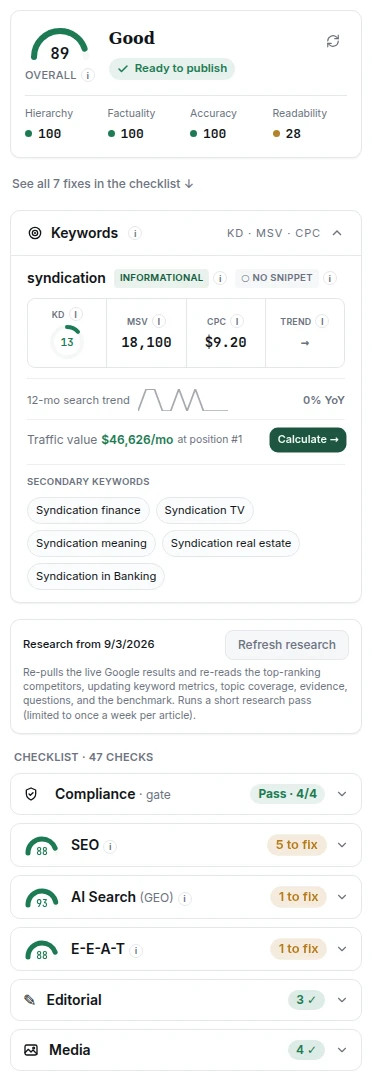
The three dials
| Dial | What it measures |
|---|---|
| SEO | Structure and discoverability: title, meta, headings, keyword placement, links, schema markup |
| AI Search | How well AI assistants can quote you: clear definitions, answerable questions, structured takeaways |
| E-E-A-T | Experience, Expertise, Authoritativeness and Trust: author attribution, citations, first-hand experience |
AI Search is the one people ask about. It's what some call GEO (generative engine optimization). Traditional SEO gets you ranked in a list of links; AI Search is about being the source an AI assistant quotes when someone asks a question. Different mechanics (quotable passages, clean definitions, explicit answers), so it's scored separately.
Each dial is scored 0–100 and built from its own group of checks: 21 for SEO, 9 for AI Search, 7 for E-E-A-T. Four of those only apply to Comparison and List articles (a comparison table and an early verdict for AI Search, a "How we chose" section and picks judged on the same criteria for E-E-A-T), so a Guide is scored on fewer.
The rest of the 55 sit outside the dials: 10 compliance checks feed the gate, 5 editorial checks (em dashes, banned phrases, leftover template markers, sources you've blocked, and table figures without a source) show as their own group, and 3 integrity checks guard the page itself.
How Overall is calculated
Overall is a weighted blend of the three dials, not a simple average. For a YMYL site the default weighting is:
- SEO: 45%
- E-E-A-T: 35%
- AI Search: 20%
E-E-A-T carries far more weight than it would for a general blog, because for a regulated or high-trust business, demonstrable expertise is the thing that actually matters.
If a dial hasn't been scored, because the checks it depends on haven't run, it's excluded and the remaining weights are rebalanced, rather than the missing dial dragging your score down.
The publish floors
There are two thresholds, and they behave as a floor, not a target:
- Overall must reach 80
- Every scored dial must reach 70
Clear both and the article is ready to publish.
Fall below either one and the editor's status badge turns from Ready to a yellow Below floor. It doesn't stop you publishing. You're the editor, and sometimes a lower score is fine for a given page. The badge is there so you decide on purpose, and the Report Card shows which dial or overall score is under its floor.
Two checks outside compliance do block, with no override: broken page markup (a tag cut off mid-way that would swallow the rest of the page) and leftover prompt or injection markers. Neither is a judgement call, so the fix is to repair or regenerate the section, not to explain it.
Warnings above the floor don't block anything. If your article scores 93 and still shows six suggestions, those are a polish list, not an obstacle. This is worth knowing because an article can look busy with recommendations and still be perfectly publishable.
The floors are the same on every plan, and so are the dials and the gate. Plans differ in volume, not in how an article is judged.
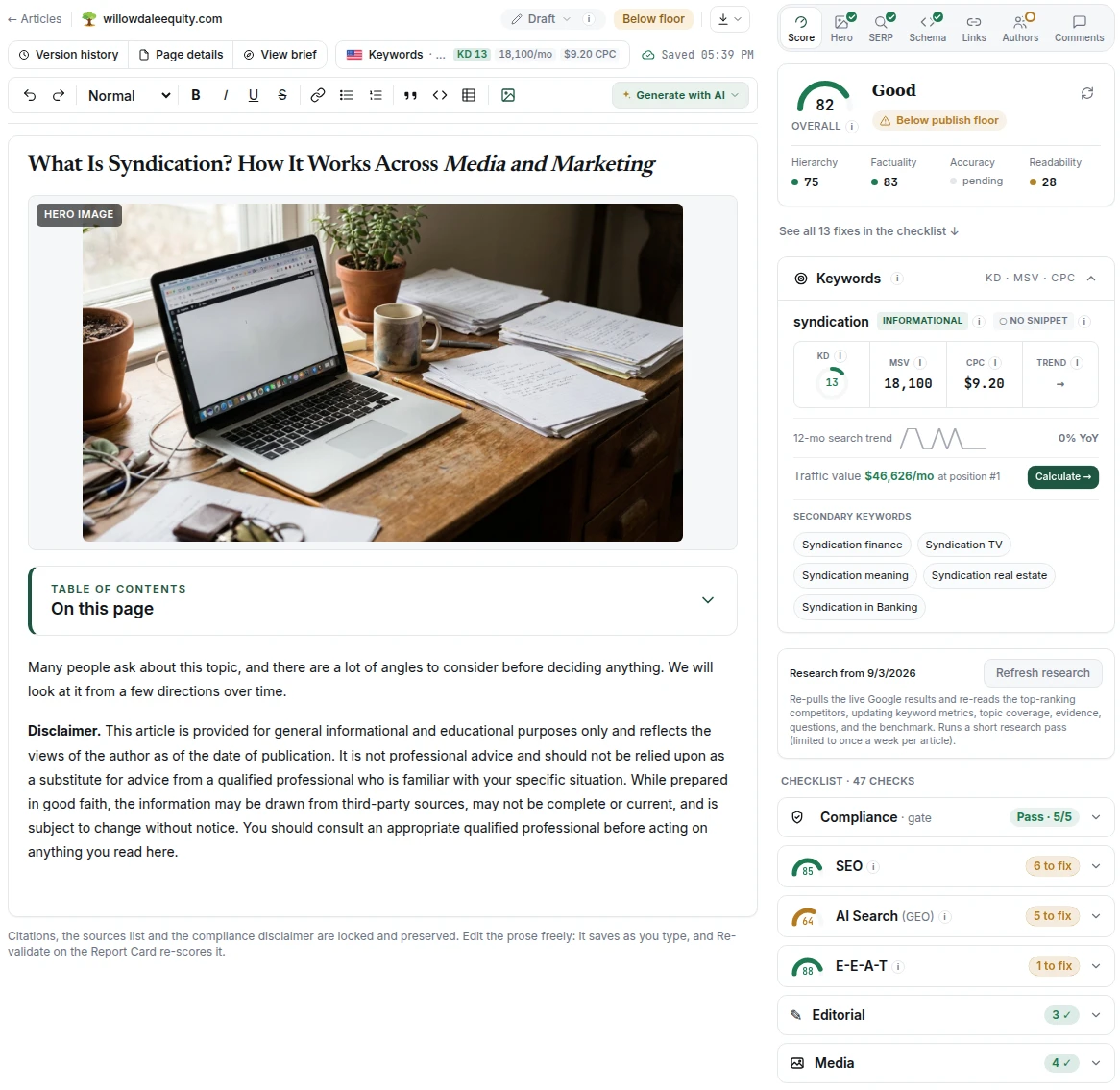
Every score item is a fix
The Report Card isn't a grading exercise: each item is an entry point. Open a failing or warning check and you get:
- What it checks and the target it's measuring against
- Why it matters, in one line
- A one-click fix where one is possible
Apply a fix and Verand re-runs the checks, so the score you see afterwards reflects the change rather than a stale number.
Two things that trip people up
An existing article can show stale scores. Verand's checks improve over time. An article validated weeks ago carries the results from back then until you re-validate it. If a score looks wrong or a check you expect is missing, hit Re-validate before assuming something's broken.
The compliance readout is not a score. It's a pass/blocked gate, deliberately kept out of the 0–100 numbers. A compliance problem isn't something you trade off against a good SEO score. See the compliance gate page.